Swim Training
How to read a swim workout: sets, target times and rest
Understand swim workout notation, repeats, pool lengths and rest with worked examples and a real DuoSwim App screen.
4 min read
By DuoSwim
A line such as 4 × 50m contains several instructions in a small space. Read the number of repeats, the distance of each repeat, the stroke or task, and the timing separately. This guide explains those details using a real DuoSwim workout preview. The displayed numbers are examples to read, not recommended paces or a workout to copy.
Start with the overview, then read the individual sets
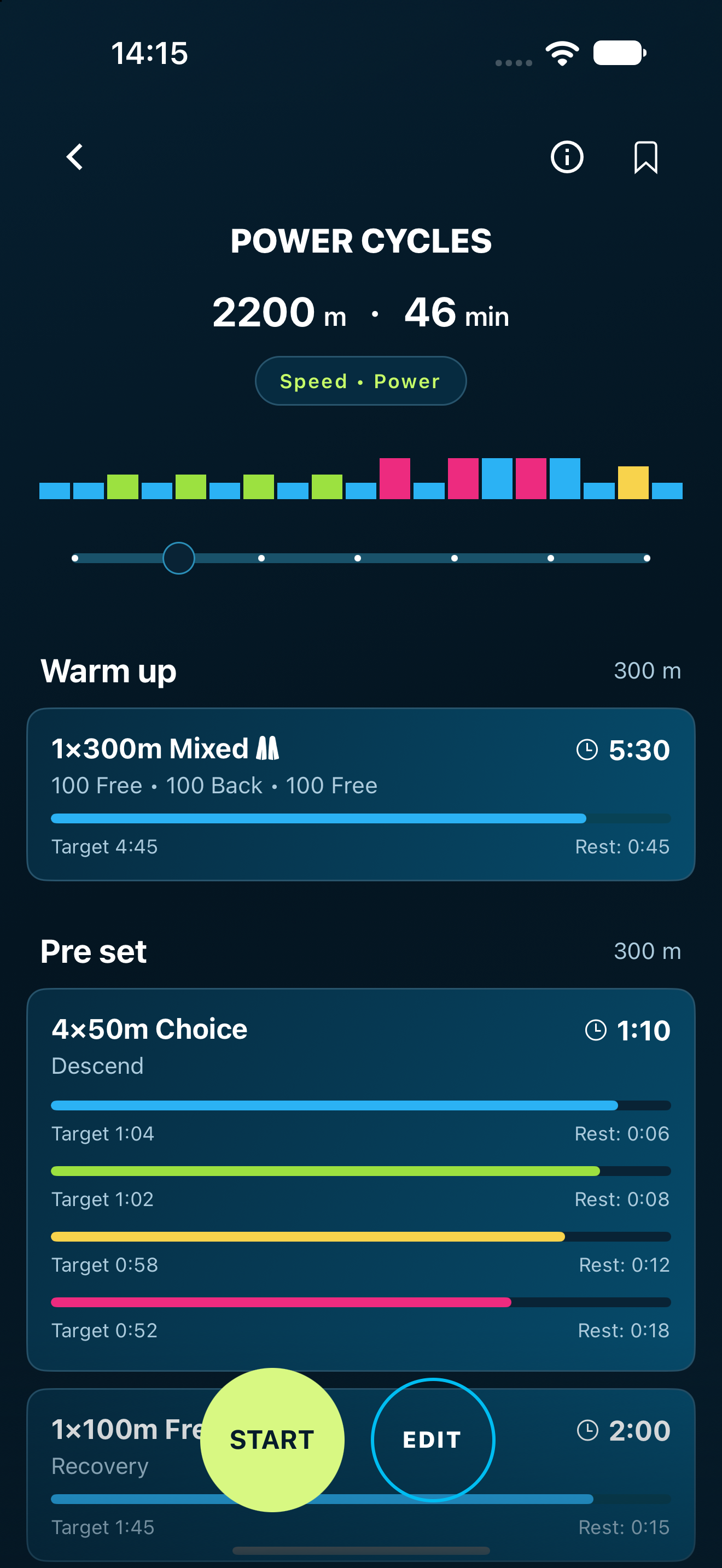
The iPhone screen below shows a workout called Power Cycles, with an overview of 2,200m and 46 minutes. Those figures describe the whole workout. The cards below break it into smaller parts, including Warm up and Pre set. This capture shows only part of the set list, so its visible cards do not represent the entire 2,200m session.
Use the overview to understand the session’s scale, then read each card’s instructions. A displayed duration is a planning estimate; it is not a guarantee of how long your pool visit will take. Your workout, targets and screen layout may differ from this example.
Read 4 × 50m as repeats × distance
The 4 is the number of repeats. The 50m is the distance of each one. Multiplying them gives 200m of swimming in that line. It does not mean four lengths unless each repeat happens to be one length of that pool.
Keep the unit beside the number. Four repeats of 50 yards total 200 yards; they do not become 200 metres. Check the workout’s units and the actual pool length before converting a distance to lengths.
| Pool length | Lengths per 50m | Lengths across 4 repeats |
|---|---|---|
| 25m | 2 | 8 |
| 50m | 1 | 4 |
Further reference: U.S. Masters Swimming: workout terminology.
Read the task underneath the distance
In the warm-up card, 1 × 300m Mixed is followed by 100 Free · 100 Back · 100 Free. That divides the 300m into three parts: 100m freestyle, 100m backstroke and another 100m freestyle. The arithmetic is 100 + 100 + 100 = 300m, not three repeats of 300m.
The next card has a different instruction: 4 × 50m Choice, with Descend underneath. Its four target times become progressively shorter. Read the words and every listed repeat, rather than assuming the same distance always means the same task or target. The coloured bars alone are not a substitute for the written instructions.
Separate the target swim time from the rest
The first 50m in the example displays Target 1:04 and Rest 0:06. In minutes and seconds, that is 64 seconds plus 6 seconds: 70 seconds, or 1:10. The card’s clock shows 1:10. The remaining rows pair a shorter target with a longer rest, while the sum stays the same.
These are the planned values shown in the preview, not recorded results from a completed swim. They do not establish what your own target should be or how much rest you actually took.
| Repeat | Target | Rest | Target + rest |
|---|---|---|---|
| 1 | 1:04 | 0:06 | 1:10 |
| 2 | 1:02 | 0:08 | 1:10 |
| 3 | 0:58 | 0:12 | 1:10 |
| 4 | 0:52 | 0:18 | 1:10 |
A fixed rest and a send-off are different instructions
In general workout notation, a fixed rest starts when a repeat finishes. With 10 seconds of rest, the gap after each swim is 10 seconds. A send-off sets the time between starts instead: on a 1:30 send-off, a 1:20 swim leaves 10 seconds before the next start; a 1:15 swim leaves 15 seconds.
Look for explicit wording such as rest, RI or on, and read any explanation supplied with the workout. A time written on its own can be ambiguous. The App example above shows target and rest separately; a different coach or workout sheet may use another format.
Further reference: U.S. Masters Swimming: send-off and rest-interval definitions.
A repeat time is different from pace per 100m
A target of 1:04 for 50m is a time for that 50m repeat. Expressed as pace per 100m, the same speed is 2:08/100m: 64 seconds × 2 = 128 seconds. That conversion does not predict a 100m result or set a training target.
When comparing numbers, check both the distance and the unit. A pace per 100 yards, a time for a 50m repeat and the estimated duration of a whole workout answer different questions. Use the calculator for the arithmetic, then return to the workout’s actual instructions.
Use this reading order before opening your next workout
First check the total distance and estimated time. Then read each set in order: repeats, distance, stroke or task, and timing. Check whether a time refers to swimming, rest or the gap between starts. Finally, distinguish planned targets from any results you review afterwards.
To explore DuoSwim, browse the existing plans and their workout lists, or see the App walkthrough. Reading a workout explains its notation; deciding whether the session suits you is a separate step. The plan-selection guide helps distinguish a plan’s audience, first workout and overall goal.
Explore swimming plans and workout previews in the DuoSwim App.
Preview your next workout in DuoSwim.
Free to download on iPhone and Android. Guided training requires an App subscription. Check the current price, renewal terms and any trial eligibility in your store.